March family home
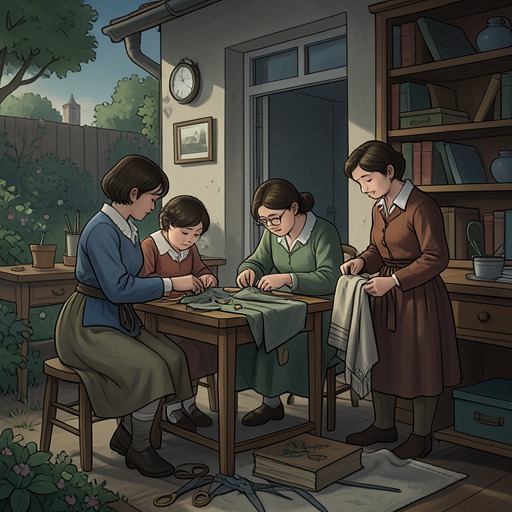
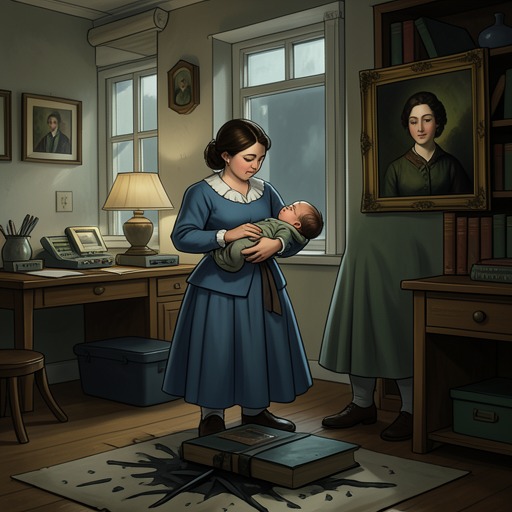
Little WomenThe March family home is the modest but emotionally powerful domestic center of Little Women. Set beside the more luxurious Laurence mansion, it makes poverty visible without making the family spiritually poor: its defining resources are shared affection, disciplined work, loyalty, imagination, and the ability to turn crisis into collective action. Across the novel, the house absorbs wartime absence, financial hardship, illness, artistic ambition, and reunion, becoming less a static building than a living structure of family memory and moral education.
Setting and Social Geography
The house stands in a suburban district that remains countrylike, with groves, lawns, large gardens, and quiet streets. A low hedge separates the March property from the estate of James Laurence. On the March side is an old brown house, bare and shabby after losing the vines and flowers that cover it in summer; opposite it is the stately stone Laurence mansion, equipped with a large coach house, carefully kept grounds, a conservatory, and glimpses of luxury behind rich curtains. The contrast establishes both a class boundary and a point of contact. The hedge marks separation, but it also makes friendship possible, allowing Jo and Theodore Laurence to look toward one another before they know how to cross the distance.
The house's modesty is repeatedly set against the Laurence mansion's abundance. To Jo, the neighboring residence resembles an enchanted palace filled with splendors no one enjoys, while the March home is crowded with activity, sisters, household duties, and feeling. When Theodore Laurence leads Jo through his library, she is dazzled by its books, pictures, statues, cabinets of coins and curiosities, chairs, tables, bronzes, and great open fireplace. Her wonder exposes the material difference between the two homes, but the comparison also implies that comfort alone cannot create companionship: the seemingly splendid mansion is lonely, whereas the poorer house is full of human presence.
Wartime Household and Daily Labor
The family home is first defined by absence. The sisters face a hard winter during the war, and Mr. March is far away with the army. Jo refuses to say that he may never return, yet each sister silently entertains the fear. Their lack of Christmas presents is therefore not merely a private economic inconvenience. Mrs. March has proposed the sacrifice because the family should not spend money on pleasure while men suffer in the army. The girls possess a dollar apiece, but even that small sum becomes a test of whether domestic comfort can be subordinated to public suffering.
Mr. March's service gives the household a specifically wartime moral shape. The sisters admire that he went as chaplain when he was too old to be drafted and not strong enough to serve as a soldier. Jo imagines serving near him as a drummer or nurse, while Amy pictures the discomforts of tents, bad food, and tin mugs. Their conversation turns the home into a place where military danger is interpreted through female concern, imagined service, and sacrifice rather than direct participation in battle.
Economic hardship becomes more acute after Mr. March loses his property while trying to help an unfortunate friend. The two oldest girls then ask permission to contribute to their own support, and their parents agree because energy, industry, and independence cannot be cultivated too early. Margaret March works as a nursery governess and earns a small salary that makes her feel rich, even though poverty remains her chief trouble. Her work exposes her daily to the dresses, bouquets, entertainments, and casual spending of the King's household, intensifying her awareness of what the March home lacks. The house thus contains both genuine contentment and the painful knowledge of unequal wealth; its moral discipline does not erase desire but teaches the family how to live with it.
Crisis, Care, and Family Discipline
When a telegraph announces that Mr. March is very ill and that Mrs. March must come at once, the quiet house is transformed in an instant. Mrs. March turns from shock to command, assigning each daughter a task: Jo must notify Mrs. King's household and gather supplies, Beth must ask James Laurence for bottles of old wine, Amy must have Hannah bring down the black trunk, and Meg must help prepare the journey. The rooms become a coordinated field of nursing, travel, and emergency work. The household's strength lies not in independence from outside help but in its ability to organize family labor while accepting the protection of trusted neighbors.
Before leaving, Mrs. March places the girls under Hannah Mullet's care and James Laurence's protection. She does not tell them to escape their anxiety through idleness. Instead, she instructs them to continue their work, calling work a blessed solace, and urges them to hope and keep busy. Her farewell also differentiates the responsibilities of the sisters: Margaret March must be prudent and watch over the others; Josephine March must be patient, avoid rash actions, write often, and remain brave; Elizabeth March is to find comfort in music and faithfully perform small household duties; Amy Curtis March must help, obey, and remain safely at home. The house is therefore maintained through a distribution of emotional and practical duties, with each daughter's character shaped by the role she is asked to perform.
The home later becomes the site of reunion and recovery. When Mrs. March returns, Elizabeth March wakes from a long healing sleep and sees the little rose and her mother's face. The household fills with genuine happiness, while the weakened girl clings to her mother even in sleep. Mrs. March recounts Mr. March's condition, John Brooke's promise to nurse him, the delays caused by the storm, and the comfort provided by Theodore Laurence's hopeful presence. The family rests after its ordeal like storm-beaten boats safely anchored, while Mrs. March remains beside Elizabeth March as if guarding a recovered treasure. Domestic space here functions as a shelter assembled through vigilance, tenderness, and shared exhaustion.
Imagination, Communication, and Transformation
The March home also produces elaborate forms of play and writing. Its proximity to the Laurence mansion supports Jo's daring visits, and Jo's route across the low porch roof and grassy bank shows how the house can be crossed creatively when ordinary social access seems difficult. The hedge becomes more than a boundary: it is a stage for curiosity, friendship, and exchange between unequal households.
The hedge eventually receives a practical and imaginative transformation through the Pickwick Club. Jo establishes a post office in the old martin house at the lower corner of the garden, stopping up its door and leaving the roof open so that letters, manuscripts, books, and bundles can pass between the households. Each side has a key. What had been a simple garden structure becomes a shared communications system, converting a physical border into an instrument of intimacy and literary collaboration. The March home consequently supports not only family life but also the sisters' experiments in authorship, club ritual, and social organization.
From Family Home to Plumfield
The house's values outlast its original domestic setting. After three years, the war is over and Mr. March is safely home, serving his small parish and remaining the family's quiet conscience, anchor, and comforter. Though five energetic women appear to rule the household in many practical matters, the scholar remains its head in the deeper sense, and the anxious women turn to him in difficult times. The home is thus restored not by the disappearance of hardship but by the return of the person whose presence completes its moral structure.
Later, Josephine March finds herself married and settled at Plumfield, where a family of six or seven boys grows around her and Friedrich Bhaer. The new household extends the old home's ethic of care to poor boys as well as rich ones, with James Laurence repeatedly identifying children in need and persuading the Bhaers to take them in. Josephine March initially makes mistakes, but Friedrich Bhaer guides her toward steadier practice, and even the most unruly boy is eventually won over. Plumfield becomes a boys' paradise, a transformed domestic institution whose disorderly abundance reverses the prim order once associated with Aunt March's property.
The continuity between the March family home and Plumfield is finally expressed in ceremony and music. During a celebration, the boys disappear and then sing from the trees a song written by Josephine March, set to music by Theodore Laurence, and trained by the Professor. Mrs. March is overwhelmed by the surprise and shakes hands with every member of the unseen choir. The scene turns the family ideal into a communal performance: affection, education, art, and care converge outdoors, while the next generation publicly inherits the emotional world created in the March home. The original house remains decisive not because its walls remain unchanged, but because its habits of sacrifice, labor, hospitality, and love continue to generate new homes.